Michael Kopp
IMAGE EMPIRE
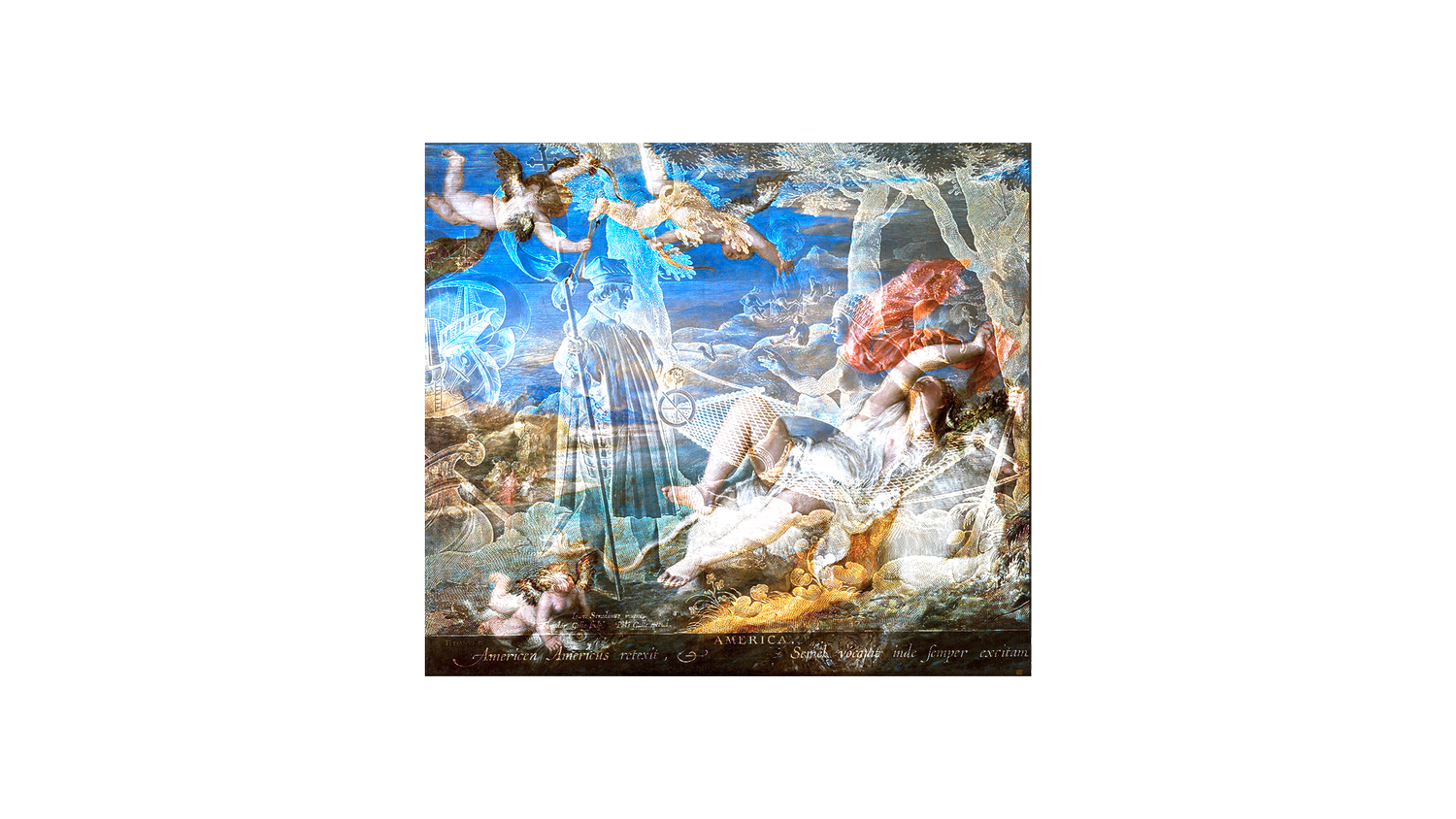
Allegory of Empire, Michael Kopp (2025)
Image Empire is an ongoing visual research project of that merges photographic series, visual archives, digital glitch interventions, still life compositions, and critical writing into a sustained inquiry on how images—past and present—mediate memory, identity, power, and possibility. Queer archival bodies, colonial architectures, and symbolic object-worlds are corrupted, fractured, and reconfigured, producing an unsettled visual archive where rupture becomes a tactic of resistance.
At the conceptual core of this project is the grid: a visual and epistemic regime forged through empire. The “longitude problem” was a major scientific and navigational challenge from the 16th to 18th centuries: how to determine a ship’s east-west position (longitude) at sea. Unlike latitude, which could be measured by the angle of the sun or stars, longitude required knowing the exact time difference between a ship’s location and a fixed reference point—Greenwich, England, would become that point. The problem was effectively solved in the 18th century through the development of accurate marine chronometers, most famously by John Harrison, supported by the Royal Navy and institutions like the Royal Naval College at Greenwich.
The Royal Naval College sat at the symbolic and literal heart of this effort, located at Greenwich—home of the Royal Observatory. By the late 19th century, Greenwich was declared the Prime Meridian at the International Meridian Conference (1884), anchoring what became the global grid of longitude and latitude. This was not just a geographic decision, but an imperial imposition—rooting global spatial orientation in British authority.
Longitude—enabled by precise timekeeping—allowed Britain to control maritime navigation, enforce colonial borders, and standardize maps. The resulting "grid" of meridians and parallels is a conceptual infrastructure of Empire: a way to fix, measure, and command the globe. It functioned as an imperial architecture, dividing space into place — knowable, governable units. In this regard, the grid is never neutral—it is an encoded worldview in which space is abstracted, claimed, and regulated.
The Royal Naval College’s solution to the longitude problem thus laid the epistemic foundation for a militarized cartographic modernity, deeply tied to extractive colonial enterprises and territorial discipline. At its core, the grid is a technology of abstraction—a way to render the messy, dynamic world into discrete, knowable, and ultimately governable units. Whether it’s land, bodies, time, or pixels, the logic is the same: break it down, tag it, and control it. This same spatial rationality underpins today’s mapping systems (e.g., GPS), real estate zoning, and even urban surveillance—all drawing upon a legacy of the imperial grid.
The Cartesian coordinate system—literally a mathematical grid—was central to Enlightenment rationalism: it underwrote the idea that space (and by extension, people and nature) could be measured, ordered, and mastered. This view of the world translated easily into colonial mapping, zoning, and eventually data systems. Nicholas Mirzoeff describes this as part of the “visuality of whiteness”—a framework that makes control look like knowledge (White Sight, 2023).
Benedict Anderson identifies the census, the map, and the museum as tools that “profoundly shaped the way in which the colonial state imagined its dominion” (Imagined Communities, 1983). The grid is the connective tissue across all three. The digital grid of metadata, coordinates, and surveillance reproduces this system on new terrain. Facebook’s database schema, Google Maps' tile system, facial recognition datasets—all follow the same imperial template: divide, categorize, extract.
The “imperial grid” and the “imperial screen” are two sides of the same epistemic coin. Both function as visual regimes—ways of seeing that structure what counts as real, valuable, and visible. The grid, as Anderson notes, allowed colonizers to imagine empty, bordered territories that could be administrated, resettled, renamed. This wasn't just about geography—it was about manufacturing legibility. “Unmapped” was synonymous with “ungoverned” and “uncivilized.” Mirzoeff's “white sight” expands on this, arguing that colonial vision is not merely representational but operational—it’s a mode of command (White Sight, 2023).
The screen (painting, photograph, cinema, and later the interface) is a projector of imperial vision that frames bodies, landscapes, and histories within a hierarchy of visibility. It teaches us what to see—and what not to. Together, they enforce what Mirzoeff calls a “visuality of order”—a way of seeing that suppresses other worldviews, collapsing multiplicity into a single-point perspective grounded in imperial certainty (The Right to Look, 2011). If the grid has historically served empire, Image Empire asks how it might be détourned: reconfigured to trace entanglements, visualize rupture, or map ungovernability.
From the Renaissance onward, painting in the West often presented itself as a pursuit of verisimilitude—the ambition to mirror reality as closely as possible. This illusionistic project aligned with the rise of humanism, scientific perspective, and colonial expansion. Perspective, in particular, became both a tool and metaphor for a supposedly objective, universal gaze—when in reality it was deeply Eurocentric and anthropocentric. Painting’s claim to truth was entangled with power and projected onto canvas.
As European empires expanded, painting was mobilized as a technology of domination. Landscape painting actively claimed land, reordering Indigenous spaces into European frameworks of ownership and resource extraction. Portraiture of colonized subjects often reinforced hierarchies of race, class, and civilization—measuring difference through a supposedly objective painterly eye. Truth was structured by colonial and racial capitalism. The “objective” gaze was actually an imperial gaze, projecting itself as the arbiter of reality. For centuries, painting’s “truth effect” rested on technical mastery: perspective, anatomy, chiaroscuro, realism — but it was always a performance of truth. Painting gestured toward truth without ever being able to fully stabilize it.
By the 20th century, the myth of painting’s objective truth was disassembled, replaced with a recognition that every image is mediated, constructed, perspectival. However, in the 19th century photography emerged as a technology that seemingly eliminated the mediating hand. Light itself illusioned to inscribe reality on a surface. What painting could only imitate, photography could, apparently, guarantee. The photograph became the modern index of truth in: science, law, ethnography, journalism. Yet, the “truth” of photography often meant the truth of classification, control, and hierarchy.
This replacement wasn’t just about accuracy — it was about institutional reallocation of truth claims; painting ceded the role of empirical capture, and photography became the apparatus of objectivity. The “objective” photograph often legitimated oppressive regimes of knowledge: maps for colonial expansion, evidence in criminology, “proof” in racial pseudoscience, and also integral for facial recognition software. Painting longed for truth, photography institutionalized it, and now both are caught in the collapse of that epistemological scaffolding — yet the power structures built on that scaffolding remain.
This is where glitch emerges—not as accident but as method. A glitch is an interruption: an unexpected moment in a system that calls attention to that system. The system being interrupted here is the visual archive of empire. Glitch artifacts are simultaneously data and process, moments where the mechanics of representation break open to reveal their own conditions. Glitch art is the intentional leveraging of interruption: provoking it, amplifying it, and recontextualizing it as critique. It is not a medium but a methodology, always time-dependent, always political, always done with purpose. Image Empire adopts this methodology, using rupture to dismantle the veneer of neutrality that has long sustained imperial archives of vision.
Outstanding Universal Value interrogates how visual regimes of colonial heritage are used to aestheticize and control, focusing primarily on the Centro Histórico de Puebla (Historic Core, Casa del Dean, Xanenetla [Mural City]) —a UNESCO World Heritage Site since 1987. Here, the camera captures the city’s meticulously preserved colonial facades, bold chromatics, and restored ornamentation, highlighting how architecture, ornamentation, and revitalization have historically been used for the projection of imperial power. The corruption of these images in Glitch as Tactic refuse the smoothness of preservation, exposing “authenticity” as an ideological veneer masking histories of dispossession and erasure. Presented alongside these series from Puebla is a portfolio which visually details the Royal Naval College at Maritime Greenwich, England — a UNESCO World Heritage Site since 1997.
God’s Eye View interrogates drone technology as a contemporary extension of imperial vision—a tool whose origins and operations are entangled in the history of settler colonialism, cartographic violence, and capitalist extraction. The drone’s aerial gaze reenacts the colonial fantasy of omniscience: a god’s-eye view that abstracts terrain into surveyable space, rendering ecosystems into textures and bodies into coordinates. The drone, in this context, reveals how vertical surveillance facilitates the management of historical narrative and visual order.
Interwoven with these image-based interventions are contemporary still life compositions from the series Phallic in Wonderland, images that reactivate the genre’s imperial origins. The Dutch Golden Age Pronkstilleven—laden with imported luxuries from colonial trade—once served as a visual script for empire, naturalizing conquest through beauty. These arrangements are reimagined in a globalized, digitized economy: imported fruits sit alongside silicone and glass phallic forms; marble vases share the frame with milk-glass familial heirlooms and mass-produced consumer goods. The human body is absent yet omnipresent, evoked through objects that signify gender, sexuality, and consumption. Drawing on cinematic theories of constructed meaning, these compositions use juxtaposition to destabilize the codes embedded in commodity aesthetics, revealing how identity continues to be mediated through material culture.
Lastly, parallel to these works is the series Glitches and Defects. An archive of recollected digitized-vintage homoerotic photographs were subject to a computer simulation modeled on patterns of HIV transmission. This algorithmic “infection” distorts the images through ruptured color channels, spectral noise, and fractured forms. Infection becomes metaphor: at once elegy and declaration, it aligns queer histories and queer viral narratives within a regime of transformation rather than erasure.
Across these interlinked series, Image Empire positions glitch not as error but as critical method: a refusal of seamless restoration, an insistence on the visibility of absence and misrecognition. The body—whether archival, architectural, or object-substituted—is understood as a contested site where systems of control are inscribed, negotiated, and resisted.
Through layered writing, poetic reflection, and theoretical analysis, the work situates itself at the nexus of trauma, memory, and anti-colonial praxis. It proposes that breaking is not a failure but a strategy—one that preserves by refusing to smooth over fracture, one that remembers by holding space for the unresolved. The result is a counter-archive in which infection becomes transformation, still life becomes critique, and heritage is reconfigured not to pacify, but to provoke.
Neo-Lexicon: a Performative Glossary for Anti-Colonial Image-Making
Neo-Lexicon: Photographic Vernacular is an evolving glossary of terms that reframe how we speak about images, place, and power. Situated at the intersection of critical theory, visual culture, and site-responsive practice, this series proposes a working vocabulary for photographic thinking—one that resists disciplinary closure and colonial taxonomies. Each entry offers a concept-in-progress: a term drawn from, or invented within, my own practice that names something latent, liminal, or unspoken in the photographic encounter.
LEGEND
(NS) — Neologism or Strategic Reappropriation
(S) — Style or Aesthetic Strategy
(T) — Theoretical or Conceptual Framework
Archive
(T) — Not merely a repository of objects or documents, but a system of power that governs memory, visibility, and historical legitimacy. Drawing on Edward Said’s notion of the cultural archive—the body of knowledge, assumptions, and imagery through which Empire came to understand, represent, and dominate the colonized world—the archive is refigured here as a colonial technology that structures what can be known, who is remembered, and how history is visualized. It is less a neutral vault and more a performative apparatus of classification, exclusion, and ideological opacity.
In photographic contexts, the archive becomes both medium and battleground: it is where the imperial gaze is recorded, and where counter-visual strategies may intervene. To engage the archive decolonially is to rupture its coherence, trace its omissions, and reimagine its contents through tactics like détournement, ré-collage, and unflattening.
See also: Cultural Memory; Palimpsest; Outstanding Universal Value; Epistemic Maneuvering; Interpellation
Dé-collage
(NS) — From the French décoller, “to unstick.” In contrast to montage’s additive logic, dé- collage implies subtraction, fragmentation, and the rupture of representational surfaces. This technique peels back the visible layers of the image to reveal the structural violences beneath. It aligns with post-representational photographic strategies that resist visual wholeness, coherence, or resolution.
See also: Glitch; Unflattening; Palimpsest
Duonotative
(NS) — A neologism combining “dual” and “denotative,” this term names an image’s ability to produce contradictory readings simultaneously. Rooted in Roland Barthes’ distinction between denotation and connotation but recast through a decolonial and para-Fanonian lens, the duonotative image coexists in paradox — at once transparent and opaque, innocent and incriminating, visible and illegible. These images embody the tensions of colonial visibility regimes.
Epistemic Maneuvering
(S) — A strategy through which dominant institutions shape what counts as knowledge, often to maintain power, erase alternatives, or naturalize colonial logics. This maneuvering occurs through selective framing, omission, aestheticization, or recontextualization — such as curatorial practices, photographic cropping, and institutional archiving. By positioning certain narratives as objective and others as illegible, epistemic maneuvering regulates visibility, authority, and belief.
See also: Interpellation; Imperial Screen; Mise-en-dispossession
Glitch
(S) — A rupture in the system, once seen as technical error, now reimagined as strategy. Informed by Legacy Russell’s Glitch Feminism, Safiya Noble’s work on algorithmic bias, and Nick Briz’s hypermedia essay Thoughts on Glitch[Art] v2.0, the glitch refuses resolution and embraces opacity. Within decolonial visuality, it becomes an act of resistance against the disciplining of digital aesthetics and the epistemological violence of clarity.
See also: Data-bending; Ostranenie
Imperial Screen
(T) — Coined and elaborated by Nicholas Mirzoeff, the “Imperial Screen” refers to the totalizing visual regime that mediates colonial power through dominant representational systems — cartography, cinema, surveillance, the rasterized image, and more. The screen occludes, disciplines, and governs perception through a white-supremacist, extractivist optic.
See also: Grid; Interpellation; Racializing Surveillance Capitalism
Mise-en-dispossession
(NS) — A critical reworking of mise-en-scène that foregrounds the spatial politics of display, curation, and framing under conditions of coloniality. Rather than simply denoting the arrangement of visual elements within a frame, mise-en-dispossession names the structural act of cultural erasure through aesthetic presentation. It exposes how beauty can be weaponized — how visual orderings often serve to pacify, possess, or aestheticize violence. In photographic practice, this concept interrogates the colonial grammar of the image: what is shown, what is excluded, and how dispossession is naturalized through composition.
See also: Outstanding Universal Value; Spectatorial agency; Worlding; Frame
Ostranenie
(T) — From the Russian Formalist tradition, meaning “to make strange.” This tactic of defamiliarization recasts the familiar as strange in order to disrupt uncritical seeing. Reimagined here for photographic practice, ostranenie exposes the constructedness of the image, particularly in genres like ethnography or documentary, where neutrality is often assumed.
See also: Glitch; Ré-collage
Outstanding Universal Value
(NS) — A UNESCO term used to determine World Heritage Sites. In this lexicon, the phrase becomes a metaphor for the imperial scaffolding of cultural memory and aesthetic legitimacy. It signals the erasure of contested, vernacular, or subaltern narratives beneath global recognition. In photographic practice, this term marks the tension between monumental visibility and minor resistance.
See also: Palimpsest; Archive
Racializing Surveillance Capitalism
(T) — Coined through the work of scholars like Ruth Wilson Gilmore, this term captures how surveillance technologies and data economies disproportionately target racialized populations. In photography, it points to practices that resist biometric capture and image profiling.
See also: Imperial Screen; Interpellation; Glitch
Ré-collage
(NS) — A neologism developed in this lexicon to describe the stratigraphic layering of street art and imagery recontextualized within the camera frame and finalized as photographic print. To ré-collage is to document, archive, and reassemble urban visuality in a manner that disrupts its ideological opacity.
Use in practice: Mass collection and rearrangement of street art photography to expose visual regimes of control and countervisualities of resistance.
See also: Photo Lexicon: Street Art; Palimpsest; Dé-collage
Systems (Image Making)
(T) — Refers to the institutional, aesthetic, and ideological frameworks that organize image production and circulation. Systems create visual taxonomies, distribute legibility, and often replicate hegemonic narratives. Image-making systems include the camera, the archive, the museum, and the media apparatus.
See also: Grid; Interpellation; Spectacle; Archive
Tactics (Image Breaking)
(T) — Drawing on Michel de Certeau’s distinction between strategies and tactics, this term refers to the ephemeral, subversive, and often unsanctioned interventions in dominant visual systems. Tactics rupture the spectacle, break frames, and operate through appropriation, parody, détournement.
See also: Ostranenie; Ré-collage; Glitch
Worlding
(T) — A term that signifies the active process of shaping, narrating, and legitimating a version of the world. In photographic practice, worlding reveals how images don’t just depict the world — they construct it, frame it, and circulate it through regimes of value and visibility.
Worlding is never neutral. It is always entangled with race, extraction, and epistemic maneuvering. UNESCO’s designation of “Outstanding Universal Value” is a paradigmatic instance: it codifies global recognition while often effacing vernacular histories. Counter-worlding, by contrast, resists this totalizing grid — often through strategies like détournement, re-inscription, and spectral layering.
See also: Archive; Outstanding Universal Value; Epistemic Maneuvering; Palimpsest
References
Anderson, Benedict. Imagined Communities. Verso, 1983.
Althusser, Louis. “Ideology and Ideological State Apparatuses.” 1970.• Barthes, Roland. Image-Music-Text. Hill and Wang, 1977.
Briz, Nick. Thoughts on Glitch[Art] v2.0. 2015, https://nickbriz.com/thoughtsonglitchart/.
de Certeau, Michel. The Practice of Everyday Life. University of California Press, 1984.
Derrida, Jacques. Archive Fever: A Freudian Impression. Translated by Eric Prenowitz, University of Chicago Press, 1996.
Fanon, Frantz. Black Skin, White Masks. Grove Press, 1952.
Foucault, Michel. The Archaeology of Knowledge and the Discourse on Language. Translated by A.M. Sheridan Smith, Pantheon Books, 1972.
Gilmore, Ruth Wilson. “The Strike Against Whiteness.”
Guevara, Francisco. Disguised Presence: Inventing Mexico as Monumental Spectacle in the National Museum of Anthropology.
Mirzoeff, Nicholas. White Sight: Visual Politics and Practices of Whiteness. MIT Press, 2023.
Noble, Safiya Umoja. Algorithms of Oppression. NYU Press, 2018.
Russell, Legacy. Glitch Feminism: A Manifesto. Verso, 2020.
Said, Edward W. Culture and Imperialism. Alfred A. Knopf, 1993.
Sousanis, Nick. Unflattening. Harvard University Press, 2015.
Vaneigem, Raoul. The Revolution of Everyday Life. 1967.